IV
The forgetting of forgetting
No longer knowing what you want: where this emptiness comes from
By Vincent Snickers · 6 min read
You no longer know what you want, and you put it down to tiredness. Yet rest changes nothing. One can suffer from a lack one no longer feels, and it is the most stable form of malaise.
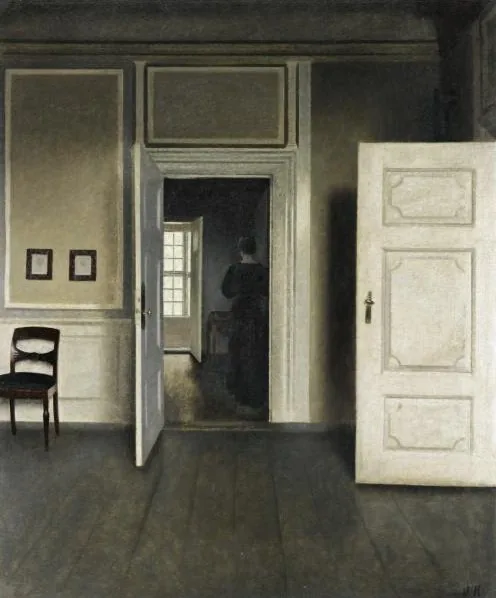
No longer knowing what would please us
At the restaurant, you hand the menu to the other person. “You choose for me, I don’t mind.” Someone asks what would please you for your birthday, and you can think of nothing. This is not politeness. You genuinely do not know.
What this costs becomes visible over time. Thomas Gilovich and Victoria Medvec studied regrets in the 1990s. In the short term, we mostly regret what we have done. Over the years, the share of what we have not done grows. A 2023 replication of the study, with around 2,600 people, found the same shift, though more modest. Bronnie Ware, who cared for the dying, reports that the first regret she heard was not having lived a life true to oneself.
When we no longer know what we want, we first believe it is tiredness, or age. Or else that we are simply made that way, without any particular passion. We wait for rest, then for serious reflection, to bring to light “what we really want”.
Neither rest nor success restores the appetite
You come back from holiday as empty as when you left. That is because tiredness and weariness are two different things. Tiredness comes from expenditure and yields to rest. Weariness comes from an absence, and rest does not touch it.
Succeeding does not restore the appetite either. Kennon Sheldon and Andrew Elliot followed students and their objectives. Those who pursued goals in tune with their own interests drew greater well-being from their success. Goals pursued under pressure or out of guilt, even once achieved, brought little of it.
As for reflection, it spins in a void, since we search with the head for precisely what the head has set aside.
Two forgettings, not one
In a session, someone speaks of an old desire, and a light passes through his eyes. Then he pulls himself together, puts the cloak of the spirit of the times back on and says: “No, but that, it’s nothing really.” He has learnt to reduce his inner voice to nothing.
The first forgetting makes us lose touch with a desire. As long as we remember it, a lack remains, and the lack makes us search. The second forgetting, the forgetting of forgetting, erases the lack itself. There is no more pain, and so no more reason to search. Yet a signal remains, faint and persistent: weariness.
The sequence is often the same. We renounce a desire, an intention of our being. We repress that intention. Then we forget the repression itself, so as to stop feeling the tear. And we wear a mask, which takes the place of the being whose movement we can no longer follow.
Here we meet again the difference between suppressing, where we set something aside knowingly, and repressing, where we no longer know. The second forgetting begins with repression.
The invisible is the invincible. What lies outside the conscious field escapes the will, since will and attention can only operate from within that field.
Leprosy gives an image of it. It makes one insensible. You walk with a shard of glass lodged in your foot and no longer feel it. The foot becomes necrotic, you do not treat it, and one day you can no longer move forward.
Two neighbouring states need to be distinguished. Alexithymia, described by Peter Sifneos in 1973, is difficulty in naming one’s emotions. Here, it is desire that is missing: one can quite well say that one is sad without knowing anything of what one would want. Anhedonia is the state in which pleasure itself no longer comes. Here, pleasure remains possible when it presents itself. What is lacking is the impulse towards it: one no longer knows what to go looking for.
A general loss of pleasure that has lasted more than two weeks, with sleep, appetite or energy affected, calls for a doctor.
Pain becomes a guide again, and the act comes before the desire
Where there is pain and discomfort, there are life forces struggling. They must be listened to. This does not rule out treatment, and a treatment that brings relief often makes listening possible. What renews the forgetting of forgetting is concluding, once relieved, that there was nothing to hear.
We can then let go of the question “what do I want in life”, which has no answer at this stage. What we have stopped doing without having decided to is almost always what put us in touch with the substance of existence. Reading, theatre, dancing, making love. We do not wait until the desire has returned before acting. We do it again, and the desire returns through the act.
The second forgetting can be recognised by a few signs.
- You don’t know how to answer “what would please you?”.
- You have given up an activity you loved, without ever having decided to.
- You say “it’s nothing” when speaking of what mattered to you.
- Rest does nothing for your weariness.
| State | Desire | The lack | What one says | What happens |
|---|---|---|---|---|
| Lived desire | Present | Absent | “I feel like” | One acts |
| First forgetting | Set aside | Present, painful | “I don’t have time” | One is still searching |
| Second forgetting | Erased | Replaced by weariness | “I don’t mind” | Nothing moves any more |
Forgetting of forgetting = renunciation + repression + disappearance of the lack. The lack is the last thread. As long as it hurts, it still leads somewhere.
Make a list of what you have stopped doing without having decided to. Reading, dancing, drawing, seeing a particular friend. Beside each line, note the year. Choose just one and do it again this week, for no useful reason.
Then, for seven days, note down each evening three preferences from the day, however small. This dish rather than the other, this street, this voice.
- Peter E. Sifneos, “The prevalence of ‘alexithymic’ characteristics in psychosomatic patients”, Psychotherapy and Psychosomatics, 1973.
- Thomas Gilovich and Victoria H. Medvec, “The experience of regret”, Psychological Review, 1995.
- Kennon M. Sheldon and Andrew J. Elliot, “Goal striving, need satisfaction, and longitudinal well-being: the self-concordance model”, Journal of Personality and Social Psychology, 1999.
- Bronnie Ware, The Top Five Regrets of the Dying, 2011.
- Jerry Richardson and Thomas Gilovich, “A very public replication of the temporal pattern to people’s regrets”, Royal Society Open Science, 2023.
If this text speaks to you, a first twenty-minute conversation is a chance to talk about it. Book a first conversation