II
The spirit behind the mask
Why the same role exhausts one person and nourishes another
By Vincent Snickers · 6 min read
One French employee in three is at risk of burnout. They are advised to do less. The advice is often right, but it is not always enough. Under the same workload, some burn out and others do not. The difference lies in what makes them work.
Exhaustion has become ordinary
You come home drained. You took a week off, and by the third day you were already thinking about what was waiting for you. You tell yourself things will be better after this project, then after the next one.
The Empreinte Humaine barometer, carried out with Ipsos BVA and published in June 2026, gives the measure of it. One French employee in two shows at least one sign of psychological distress, and 32% are at risk of burnout.
The explanation seems obvious: we wear ourselves out because the load is too heavy, and it would be enough to do less, to rest or to change jobs.
Under the same load, not everyone burns out
In 2003 Robert Vallerand described two ways of being passionate about the same activity. In harmonious passion, one can stop without drama. In obsessive passion, the worth one grants oneself depends on the activity, and one cannot keep from going back to it. In 2010, his team studied nurses in France and in Quebec. Among the Quebec nurses, followed over six months, obsessive passion predicted more burnout, because of the conflicts it creates with the rest of life. Harmonious passion predicted less.
Rest, for its part, does not rest everyone. Some people, as soon as they stop, feel guilty, and come back from leave more tense than when they left.
And those who change jobs often start all over again. We resign, we move, and somewhere else we go back to doing five times too much.
Behind the role, there is a spirit
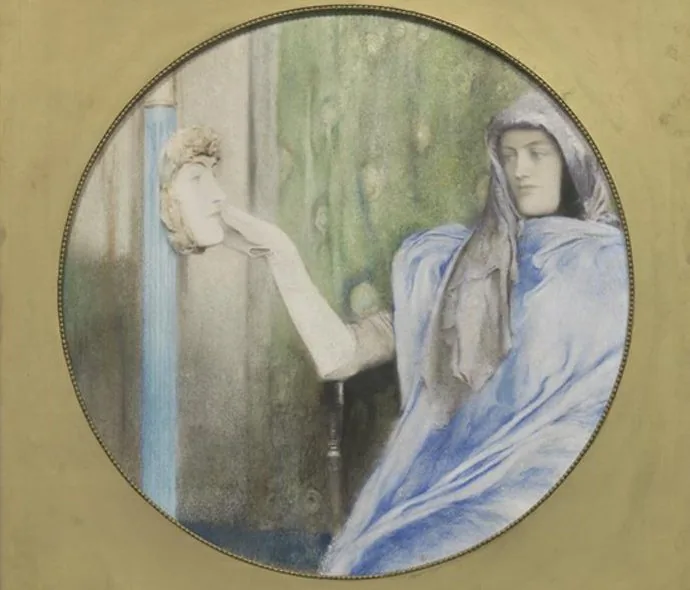
There are the roles, the persona. And there is the vital intention that animates the role. Masks, whatever their form, serve a centre of gravity that gives them their impetus. It is this centre that I call the spirit of a role.
Nietzsche, in Thus Spoke Zarathustra, describes three metamorphoses of the spirit. I read them as three centres of gravity: the camel’s “I must”, the lion’s “I will”, the child’s “I create”. The camel acts to earn its place. The lion acts to prevail, in front of others or against them. The child acts for the thing itself.
The camel looks for a duty. It loads itself up to feel respectable and to feel its strength. Nietzsche lists what it imposes on itself: humbling oneself to wound one’s pride, loving those who despise us. The Atlas complex is the camel.
The psychology of motivation has rediscovered this figure. Richard Ryan and James Connell showed in 1989, with schoolchildren, that the same behaviour can rest on very different reasons. One of them is introjection: I do it so as not to feel guilty, or to be worth something. It is the “you must” turned inward, and in these schoolchildren it went hand in hand with greater anxiety.
Not every duty is a camel. The same theory distinguishes introjected duty, carried out so as not to feel guilty, from endorsed duty, carried out because one cares about it. Sitting up with a sick child is a duty, and few parents feel diminished by it. The camel begins when duty serves to earn one’s place.
The three facts from the beginning then make sense. The nurses did not have the same spirit. The camel at rest is still a camel, and it feels at fault. We take our spirit with us from one job to the next. Sometimes the mask is false. Sometimes, too, the role suits us and it is the spirit animating it that is false.
We can keep the role and change what animates it
A teacher, a mother, had stopped painting and stopped reading for herself. She held all her roles in self-denial. She kept her job and her family, but she shared out the burdens, accepted the recognition she was owed, and stopped hiding her light under a bushel.
To find out which spirit is holding a role, imagine interrupting it for a month. What you feel first will tell you.
- Guilt. That was the camel.
- The fear of being overtaken or of losing your standing. That was the lion.
- Missing the thing itself. That was the child.
Missing it in a way that leaves you at peace points to the child. Missing it in a way that turns into rumination, with the feeling of no longer being worth anything, still points to the camel. And if the guilt concerns people who would genuinely be left with no one to take over, it comes from the missing back-up, not from you.
This reading does not excuse us from looking at the workload. A job that asks too much of too few people also wears out those who love it, and that is something to settle with the employer. Entrenched exhaustion, with damaged sleep, crying, dark thoughts or being unable to go back to work, should first be seen by a doctor.
| Spirit | Its phrase | Where worth comes from | When it stops | Its dead end |
|---|---|---|---|---|
| Camel | I must | From duty done | Guilt | Serving endlessly, with no oasis |
| Lion | I will | From the gaze and envy of others | Fear of being overtaken | Winning without ever being sated |
| Child | I create | From the thing itself | Missing it | Less visible, isolation |
Exhaustion = load − recovery. The “I must” weighs on the second term: it forbids recovery.
Make a list of your roles. For each one, share out ten points between the camel, the lion and the child. Do not try to get rid of the camel. Look for the role where the child is at zero, and for what would give it back a point.
- Friedrich Nietzsche, Thus Spoke Zarathustra, “On the Three Metamorphoses”, French trans. Henri Albert.
- Richard M. Ryan and James P. Connell, “Perceived locus of causality and internalization”, Journal of Personality and Social Psychology, 1989.
- Robert J. Vallerand et al., “Les passions de l’âme: on obsessive and harmonious passion”, Journal of Personality and Social Psychology, 2003.
- Robert J. Vallerand, Yvan Paquet, Frederick L. Philippe and Julie Charest, “On the role of passion for work in burnout: a process model”, Journal of Personality, 2010.
- Empreinte Humaine and Ipsos BVA, barometer of the psychological health of French employees, 16th edition, June 2026.
If this text speaks to you, a first twenty-minute conversation is a chance to talk about it. Book a first conversation