I
The realm of the mask
Persona and the social mask: why we play a role, and how not to lose ourselves in it
By Vincent Snickers · 6 min read
You have been told to be yourself and to drop the mask. This advice relieves no one, because it aims at the wrong target. Wearing a mask has never been the problem. The problem begins the day we can no longer take it off.
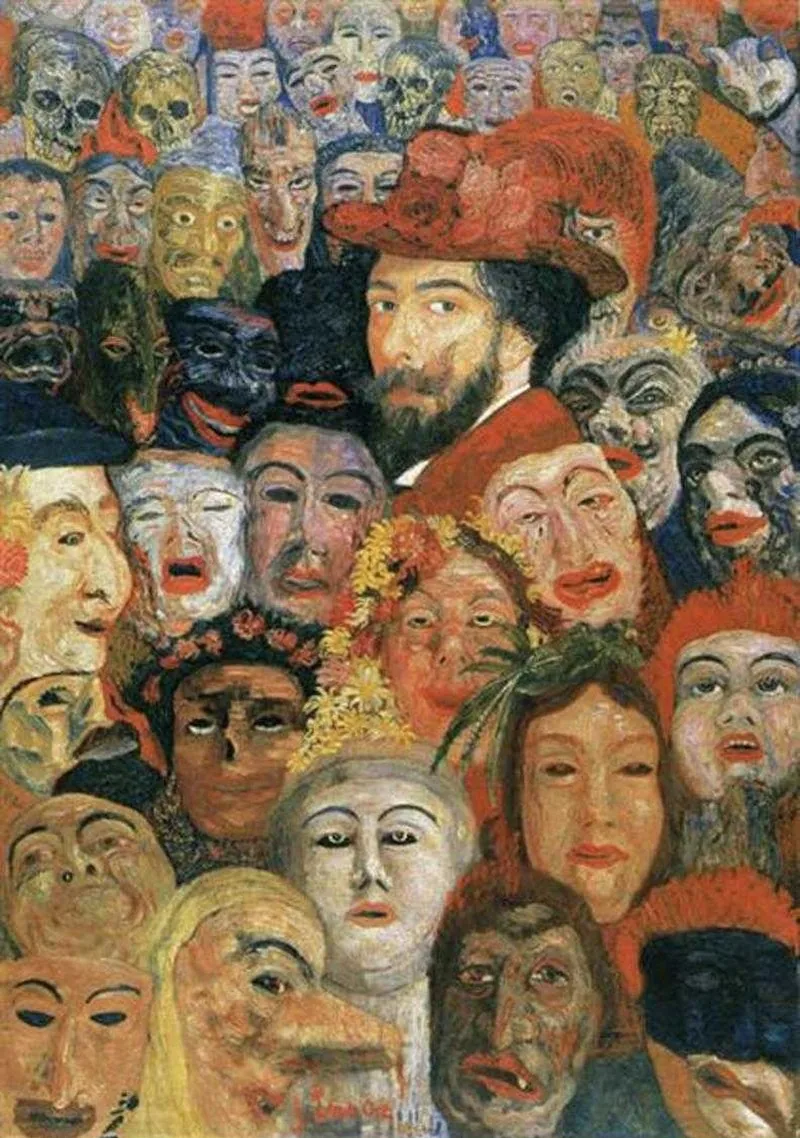
Holding your role, and no longer knowing who you are
Someone asks who you are, and you answer with your job. On Sunday evenings, on holiday, in retirement, when the role stops, something drifts. You no longer quite know what to do with yourself.
There is an indirect measure of this. In a 2023 survey of 1,269 American employees by Deloitte and New York University, six in ten said they hid a part of themselves at work that they felt was frowned upon. Of those, six in ten said it left them drained.
The usual explanation fits in one sentence. The mask is a lie, it cuts us off from ourselves, so it has to come off. Be genuine, say what you think, show yourself as you are.
Without a mask, we can no longer act, and the role does not always wear us out
I knew a magistrate who, after her father’s death, could no longer pass judgement. She wondered who she was to do so. She had forgotten that it was never she who judged, but the role the collective had entrusted to her. The judge who puts on the robe deceives no one.
The sociologist Arlie Hochschild distinguished two ways of holding an emotional role. In surface acting, we display what we do not feel. In deep acting, we summon within ourselves the feeling that is expected. A synthesis of 95 studies, published in 2011 by Ute Hülsheger and Anna Schewe, clearly links the first to exhaustion, and the second hardly at all. The role alone, then, is not enough to explain the fatigue.
A mask either serves, or it possesses
In Italian, maschera means false face. Jung borrowed from the Romans the word persona, the actor’s mask, to name the compromise each of us strikes with society about what we appear to be. The persona is an organ of adaptation. It modulates being so that it can enter into relation with the collective.
Three words resemble one another here, and they need to be told apart. The social role is what the collective expects of a function. The persona is the way I take it on, my compromise with that expectation. The false self, described by Winnicott in 1960, is an early defence, built by a child who had to conform in order to survive. Winnicott makes clear that there is a healthy form of it: politeness, good manners in society. The false self becomes pathological when it is taken for the whole person. A persona can be set down. A false self comes undone slowly, most often with someone’s help.
The dividing line, then, runs inside the mask. A mask that serves is a mask in which the life drives are still fighting, where there is still some maquis and some resistance left. A mask that possesses reigns unchallenged. It governs being according to its own logic, its role and its borders, and nothing spills over.
This difference also sheds light on the 2011 synthesis. What wears us out is the gap between what we show and what we feel. The mask that possesses has done away with that gap, which is why it does not wear us out straight away. Its cost appears elsewhere, and later. Jung had noted it: the more perfect the mask in public, the more private life pays the price, in moods and in symptoms.
People speak of the Man in the Iron Mask, the prisoner of Louis XIV. The real prisoner wore a velvet mask. We are not imprisoned by violence, we are imprisoned by gentleness, and no one rebels against velvet. The mask that possesses is the one that is comfortable and that pays.
Finally, one mask calls forth another. When a police officer, a doctor, a president comes towards me in their role, their persona expects from me a response to match it. If my mother, when I am thirty, speaks to me as if I were ten, she invites me to become a child again. Our masks are partly dictated to us by the masks facing us.
The question becomes “can I take it off?”
We no longer have to reproach ourselves for playing a role. We check that someone is still there to hold it, and this can be observed.
- Backstage. Is there a place, or a person, in front of whom you perform nothing?
- The wind-down. How long does it take you, once home, to drop the tone of work? If the answer is “never”, the mask no longer comes off.
- Your first name. Introduce yourself out loud without your job, your family status or your achievements. Notice what remains.
If what remains is an emptiness that lasts and frightens you, this is no longer an exercise to do alone.
| State | Who holds the role | Can it be set down | What it costs |
|---|---|---|---|
| No mask | No one | There is none | Exposed, unable to act in the world |
| Mask that serves | Me, knowingly | Yes, backstage | An effort, from which one recovers |
| Mask that possesses | The role itself | No | Nothing at first, then private life and the body |
Mask that serves = role + awareness of playing + a place where one does not play. Possession = role alone.
Take four people: your mother or your father, your manager, your partner, a friend. For each one, note the role you play, the role they expect, and what their own mask asks you to become, like the mother who speaks to her thirty-year-old son as if he were ten.
The aim is to observe, so that one day you can say: I possess my masks, none of my masks possesses me.
- C. G. Jung, The Relations between the Ego and the Unconscious, Gallimard.
- Donald W. Winnicott, “Ego distortion in terms of true and false self”, 1960, in The Maturational Processes and the Facilitating Environment, 1965.
- Arlie R. Hochschild, The Managed Heart, 1983, French trans. Le Prix des sentiments, La Découverte, 2017.
- Ute R. Hülsheger and Anna F. Schewe, “On the costs and benefits of emotional labor: a meta-analysis of three decades of research”, Journal of Occupational Health Psychology, 2011.
- Deloitte and the Meltzer Center (New York University School of Law), Uncovering Culture, 2023.
If this text speaks to you, a first twenty-minute conversation is a chance to talk about it. Book a first conversation